
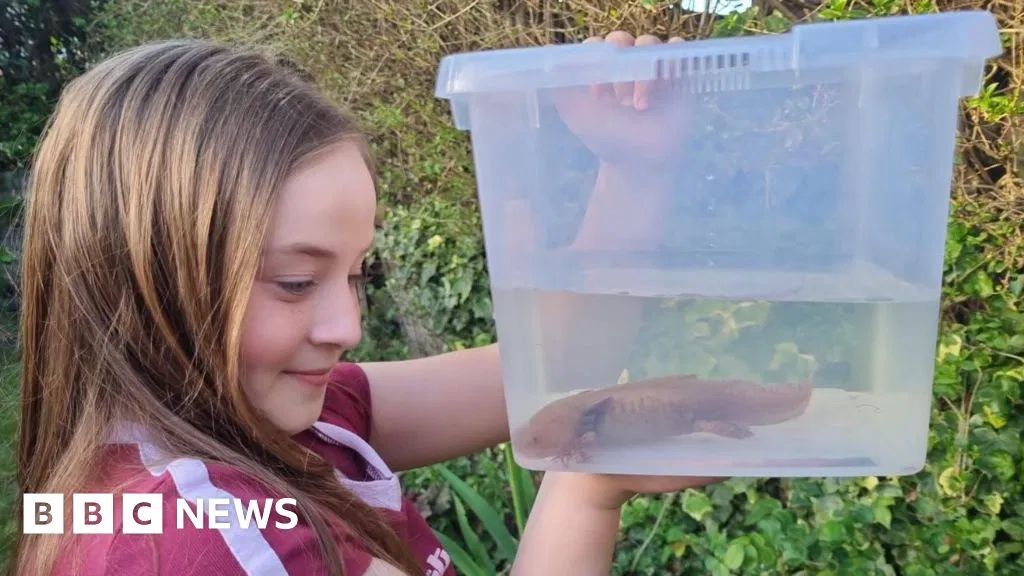
A 10-year-old girl on a family trip to the Welsh countryside stumbled upon a discovery that has captured hearts worldwide: a critically endangered Mexican axolotl, found living under a bridge in the River Ogmore. The incredible find is believed to be the first time a wild axolotl has ever been recorded in the United Kingdom, prompting both excitement and important conversations about exotic pet ownership.
How It Happened: A Family Day Out Turned Extraordinary
On April 10, 2026, Melanie Hill and her 10-year-old daughter Evie were exploring the River Ogmore near Bridgend in south Wales during a holiday trip. While wading knee-deep in the water, Evie spotted something unusual beneath Dipping Bridge — a nine-inch amphibian with feathery external gills and a distinctive smile. "Mum, there's an axolotl in the river," she told her disbelieving mother.
Melanie Hill described the moment as one of "shock, surprise, and disbelief." Speaking to reporters, she said she couldn't believe what her daughter had found. The family quickly realized the creature was not a native species — Mexican axolotls (Ambystoma mexicanum) are native only to the lake systems of Xochimilco and Chalco in central Mexico, more than 5,000 miles away.
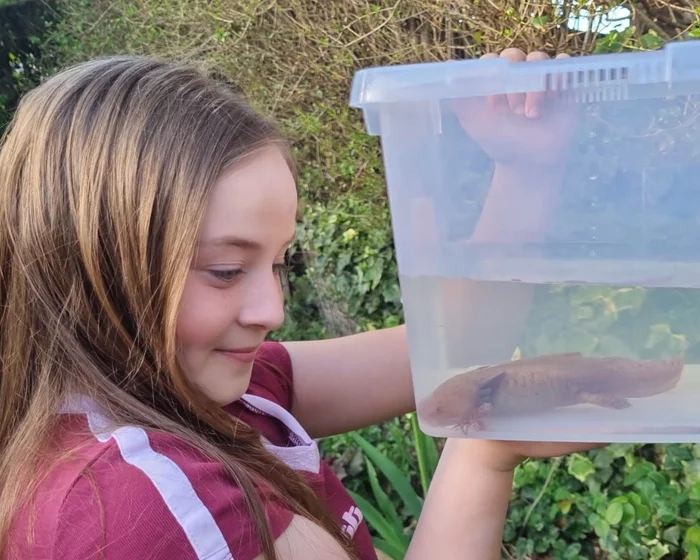
The family named the axolotl "Dippy" after Dipping Bridge, the structure under which it was found. Experts believe Dippy was likely an abandoned pet or an escapee from a private collection. Axolotls are popular in the exotic pet trade and are bred in captivity around the world, but they are not native to any part of Europe.
Timeline: From Discovery to Rescue and Recovery
April 10, 2026 — Evie Hill discovers the axolotl under Dipping Bridge on the River Ogmore in Bridgend, south Wales. The amphibian shows signs of injury, including damage likely caused by a predator attack. The family carefully collects Dippy and begins researching how to care for the animal.
April 11-14, 2026 — The family sets up a temporary home for Dippy in a fish tank, monitoring its health and documenting its recovery. They reach out to wildlife experts for guidance on proper care.
April 15-20, 2026 — News of the discovery begins circulating locally. Chris Newman, director of the National Centre for Reptile Welfare, is contacted and confirms that Evie likely saved Dippy's life by rescuing the injured amphibian from the wild Welsh river, where cold temperatures and predators posed serious threats.
April 23, 2026 — Major news outlets including BBC News, The Guardian, and The Independent report on the discovery, calling it the first recorded wild axolotl found in the UK. The story goes viral internationally.
Present Day — Dippy continues recovering in a carefully maintained tank. The family has started documenting Dippy's journey on TikTok, raising awareness about axolotl conservation and responsible pet ownership.
Why This Matters: The Bigger Picture for Axolotls and Pet Owners
The discovery of Dippy in a Welsh river is remarkable not just for its rarity, but for what it highlights about the global axolotl crisis. According to conservation organizations, fewer than 1,000 axolotls remain in their native wild habitat in Mexico. The International Union for Conservation of Nature (IUCN) lists the species as Critically Endangered, with populations declining due to pollution, habitat loss, invasive species, and overexploitation.
Chris Newman of the National Centre for Reptile Welfare told BBC News that Evie "probably saved Dippy's life" by acting quickly. "Axolotls are incredibly delicate creatures not equipped to survive in UK rivers," Newman explained. "The water temperature alone would have been a significant challenge, not to mention native predators."
This story also serves as an important reminder about exotic pet ownership. Axolotls are fascinating animals with unique care requirements that make them challenging pets for beginners. They require cool, clean water (ideally between 60-64°F), a high-protein diet of earthworms and specialized pellets, and a tank setup that includes hiding spots and gentle filtration — axolotls are sensitive to strong currents.
Many pet owners may not realize that axolotls can live up to 15 years in captivity and grow to 12-14 inches. Their remarkable ability to regenerate limbs, spinal cord tissue, and even parts of their brain has made them popular in scientific research, but their specific care needs mean they are not suitable for casual pet owners.
Where Things Stand Now: Dippy's Ongoing Recovery
Dippy is now recovering well in a temperature-controlled tank under the Hill family's watchful care. The amphibian's injuries from the suspected predator attack are healing, and Dippy has begun eating regularly — a positive sign according to the family. The Hills have been documenting the recovery process on TikTok, where videos of Dippy's journey have garnered millions of views across multiple platforms.
The family has received guidance from reptile and amphibian welfare experts on proper axolotl care, including water quality management, appropriate feeding schedules, and long-term habitat planning. While the exact future home for Dippy has not been finalized, discussions are ongoing with wildlife centers about the best permanent placement for the celebrity axolotl.
What Happens Next: Dippy's Future and Conservation Awareness
Experts expect that Dippy will ultimately be placed with a specialized aquatic facility or experienced keeper who can provide the lifelong care this critically endangered species requires. The case has sparked renewed interest in axolotl conservation, with wildlife organizations using the story to educate the public about the species' precarious status in the wild.
For pet owners considering an axolotl, experts emphasize the importance of research and preparation. Axolotls require a minimum 20-gallon tank, a secure lid (they are known to attempt escape), a chiller to maintain cool water temperatures in warmer climates, and a commitment to regular water testing and changes. Unlike many amphibians, axolotls remain fully aquatic throughout their lives and should never be removed from water for extended periods.
Key Takeaways
- A historic first: This is the first recorded instance of a Mexican axolotl found in the wild in the UK, more than 5,000 miles from its native habitat in Mexico
- Critically endangered: Fewer than 1,000 axolotls remain in the wild, and the species is listed as Critically Endangered by the IUCN
- Likely an abandoned pet: Dippy was probably a captive-bred animal that was released or escaped, highlighting the responsibilities of exotic pet ownership
- Rescue success: Quick action by 10-year-old Evie and her family, along with guidance from the National Centre for Reptile Welfare, saved Dippy's life
- Raising awareness: Dippy's story has gone viral on TikTok and social media, bringing global attention to axolotl conservation