
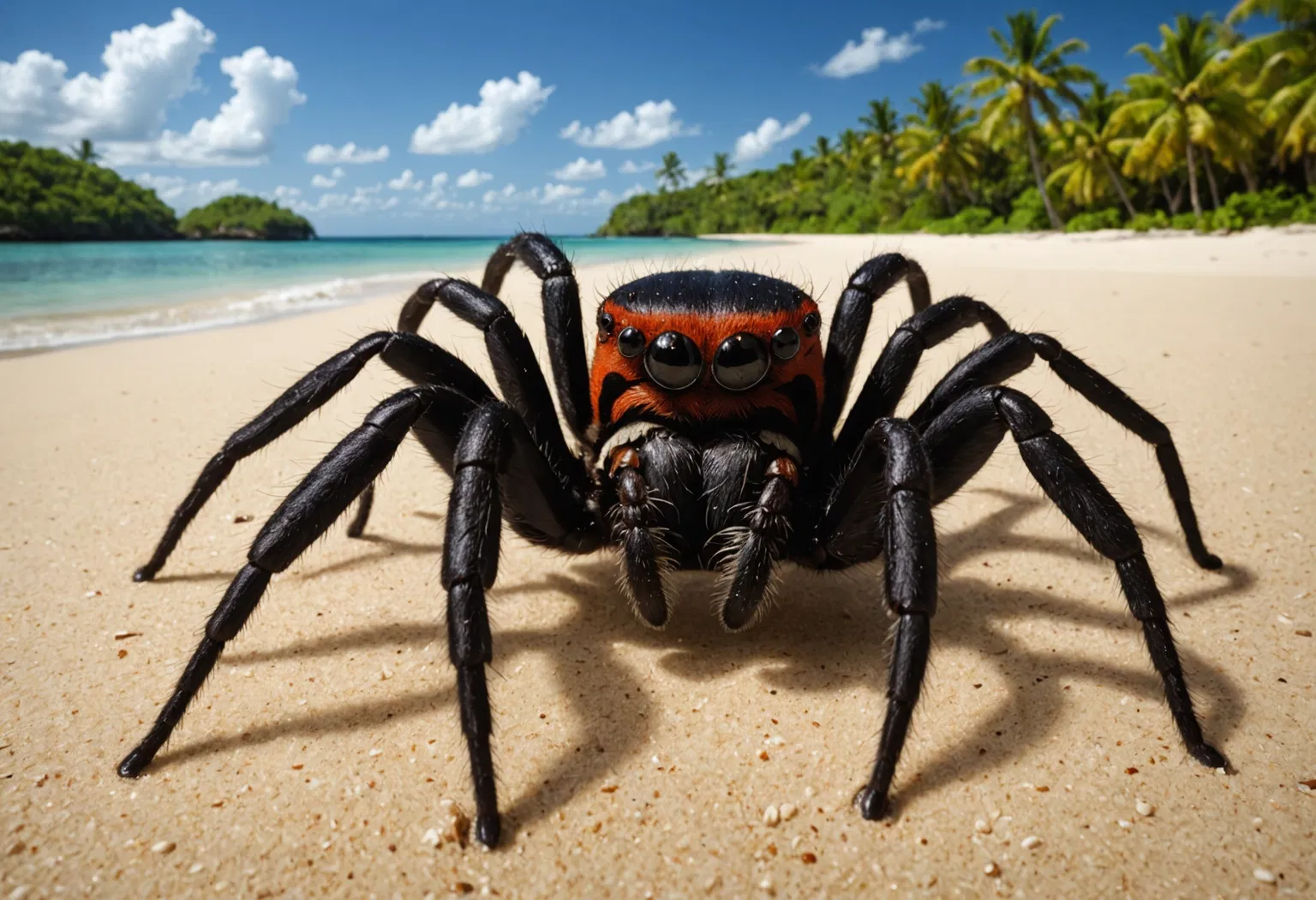
The ocean rolls in and swallows the rocky shore, flooding it completely - yet sealed behind a tiny trapdoor of silk, sand and algae, a spider sits out the high tide in total safety. That spider is the Mauritian tidal trapdoor spider (Idioctis marevallum), and it has just been formally described as a species new to science, ending a discovery story that began with a scream on a one-hectare islet off the coast of Mauritius.
The arachnid is a mygalomorph - the same primitive group that includes tarantulas - in the brush-footed trapdoor spider family Barychelidae. It is one of only a handful of spiders on Earth known to live in the intertidal zone, where its home is flooded twice a day. Conservationists from Durrell Wildlife Conservation Trust and its partners first found it in 2023 during island-restoration work, and it has now been officially named Idioctis marevallum in the journal Arachnology.
An Eight-Legged Surprise That Started With a Scream
The discovery is as memorable as the animal itself. Nik Cole, a scientist at Durrell Wildlife Conservation Trust, recalls the moment his colleague Max first spotted the spider. "The thing I remember most is Max screaming at me to come over because he'd just seen a mygalomorph - a trapdoor spider," Cole said, adding that he could hardly believe what the pair had stumbled across.
The team was on Ilot Vacoas, a tiny one-hectare island off the southeast coast of Mauritius, carrying out conservation work. The spider gave itself away only by a glimpse of its long legs poised outside a small trapdoor - a nocturnal hunter that had carved its home into coral rock right at the water's edge.
Formally describing the species took several years. Researchers compared it with close relatives across the Indian and Pacific Oceans, including the intertidal and mangrove-dwelling Idioctis spiders of the western Pacific and the Christmas Island trapdoor spider (Idioctis xmas). In 2026, Sherwood, Cole, Falconer, Ferguson and Tercel published the description of Idioctis marevallum in Arachnology (volume 20, pages 608-622), with the species subsequently added to the World Spider Catalog.
A Trapdoor Built to Beat the Tide
What makes this spider extraordinary is where it lives. Most trapdoor spiders dig burrows in dry soil and simply wait for prey to wander past the closed lid. Idioctis marevallum instead shelters inside tubes and crevices of coralline bedrock in the intertidal zone, where the incoming tide completely submerges its home.
To survive, the spider seals the entrance with a trapdoor fashioned from silk, sand and algae, protecting itself against high tides and waves until the water recedes. Its legs are stout and muscular, equipped with specialized combs and spines for excavating damp sand, mud and organic debris from its burrow.
This tidal lifestyle is vanishingly rare among spiders. The intertidal trapdoor spiders of the genus Idioctis are among the few mygalomorphs to have adapted to regular saltwater flooding - a feat that continues to fascinate arachnologists and, increasingly, the wider spider-keeping community.
From a 2023 Scream to a Named Species: The Timeline
The road from chance sighting to named species unfolded over three years:
2023: During island-restoration work on Ilot Vacoas, conservationists glimpse the spider's legs behind an open trapdoor in coralline bedrock.
2023-2026: Researchers study, photograph and compare the spider with related Idioctis species across the Indian and Pacific Oceans.
2026: The species is formally described as Idioctis marevallum in the journal Arachnology by Sherwood and colleagues, and entered into the World Spider Catalog.
October 2026: Durrell Wildlife Conservation Trust publicly announces the discovery, bringing the story to a global audience.
Why This Spider Matters - for Conservation and Arachnid Lovers Alike
Idioctis marevallum is far more than a curiosity. It was one of 14 spider species newly recorded for Mauritius in the same study - together representing more than a quarter (roughly 27%) of the 51 spider species now known from the island. It is also the eighth new species described from Durrell's Arachnid Taxonomy Project, underscoring how little is known about Mauritius's invertebrate diversity.
As a flagship endemic species found on a single tiny islet, the spider carries real conservation weight. Ilot Vacoas is small and isolated, and the species' survival is tied to the health of that intertidal shoreline and its coralline bedrock.
The find has also delighted the exotic-pet world. Trapdoor spiders belong to the same mygalomorph group as tarantulas, which are among the most popular - and lowest-maintenance - invertebrates kept as pets. Keepers prize them for their modest space needs, infrequent feeding and fascinating burrow-building behavior. While Idioctis marevallum is a protected, endemic species that should never be collected for the pet trade, its discovery is a vivid reminder of the adaptations these animals are capable of - even if no home enclosure can recreate a twice-daily ocean tide.
Where Things Stand Now
The Mauritian tidal trapdoor spider is now formally cataloged and recognized, with its name, description and type locality recorded in the World Spider Catalog. Durrell's team continues its survey work across Mauritius, and the Arachnid Taxonomy Project is expected to yield further discoveries in the months ahead.
What's Next for the Tidal Trapdoor Spider
Researchers are likely to keep monitoring the spider's habitat on Ilot Vacoas and nearby islets, with the discovery adding momentum to conservation of Mauritius's unique coastal ecosystems. Given that a single study added 14 species to the island's spider list, arachnologists suspect more undescribed species are waiting in the coral rock - and the next one may be hiding just behind another tiny trapdoor.
Key Takeaways
The essentials to remember about the Mauritian tidal trapdoor spider:
- It is Idioctis marevallum, a newly described mygalomorph in the brush-footed trapdoor spider family Barychelidae.
- It lives in the intertidal zone of Mauritius, where its burrow is completely submerged at high tide.
- It seals itself in with a trapdoor made of silk, sand and algae while sheltering in coralline bedrock.
- It was first spotted in 2023 on Ilot Vacoas and formally described in 2026.
- It was one of 14 new spider species recorded for Mauritius - more than a quarter of the island's known spider diversity.
- It is a protected endemic species and should never be collected for the exotic-pet trade.